By Dimitri Limata, COO at MoiraCorp. Humboldt Financial is a UK FCA-regulated advice firm that runs on the Plannr platform. Like many growing advice businesses,
Explore how AI is reshaping compliance for IHT 2027. Understand the frameworks and operational shifts impacting financial advisers.
Retrieval Augmented Generation (RAG) augmented by ML can help in Proactive Risk Identification enabling predictive analysis to identify potential issues regarding unbalanced customer selection.
Most firms are sitting on data that could predict which clients are at risk or which investments are underperforming. Machine learning is the type of artificial intelligence that enables computers to learn from this existing knowledge and data.
GenAI can adopt a persona and “make decisions” or “behave” in a way that can be quantified. This technique is used to simulate scenarios, which can then be analyzed quantitatively and used in particular to assess multi-criteria decision alternatives
Extracting quantitative information using GenAI tools requires to properly structure the prompts used to question them to efficiently use their large language models (LLMs)
Machine learning is a type of artificial intelligence that enables computers to learn from existing knowledge and experiment results. These models are traditionally used for prediction and can be augmented by GenAI for training data generation and screening in particular
Retrieval Augmented Generation (RAG) is a critical technique using proprietary or domain specific documents to augment base LLMs to address specific enterprise or applications needs.
The use of AI agents offers a significant leap forward from traditional task automation by infusing intelligence, adaptability, and autonomy into critical IT processes.
GenAI can “read” text and assign numerical values or categories that can then be counted or classified. When appropriately queried, the values can be turned into probabilities of assertion.
Prompt engineering and RAG can be used cooperatively to process knowledge represented through expert oriented rules (if-then statements) and enable deductive reasoning leading to enhanced decision making
Most UK advisory firms are buying AI tools before they understand how AI actually works. That’s the wrong order. Five free, widely-respected resources every leader should read before they spend anything — covering prompting, AI behaviour, adoption frameworks, FCA expectations, and risk management.
McKinsey says over 80% of corporate AI adopters see no earnings impact. HBR explains why — it’s a general-purpose technology like electricity, not a quick win. Here’s the honest framework for evaluating whether AI will actually pay back in your firm.
McKinsey and MIT have been telling us why AI projects fail. The findings line up with what we see across our client work — and most of it is fixable. Five traps, four playbook moves.
Three sides of financial services — investment banking, running a business, advising regulated firms — and the same pattern in all of them. Capable people losing time to workflows that were never designed for the business they became.
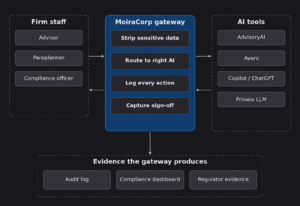
IHT 2027 brings 213,000 estates into scope and a capacity squeeze that AI will be expected to absorb. Here’s why the workflow needs to be a compliance question first.
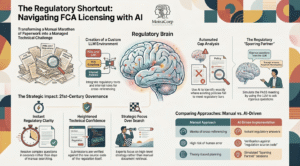
A small experiment in turning FCA regulatory complexity from a manual marathon into a technical problem — and what it means for any firm staring at thousands of pages of paperwork.

The considerable amount of information contained in GenAI “clouds” makes them almost indispensable to user interface in product marketing, finance or legal assistance.